
DIY: Tree weeds at your place
Knowing how and when to kill a weed species is as important as being able to identify it correctly. Once you’re sure you’ve got the plant right, here are some methods for dealing with it. More specific advice is available on the page for each species – just search our weed archive for more information.
Cut and paste
Cut and pasting works well for plants that are too big to pull out and small enough that you can fell them with a saw or loppers. Be sure to check the species page for the weed you’re removing, as some don’t require herbicide treatment at all.
- Cut as close to the ground as possible.
- Apply herbicide gel as soon as you can to the cambium layer. This is the wet-ish layer immediately underneath the bark of the tree which is the water network for the plant. Peeling back some of the remaining bark around the stump can help too.
- Dispose of the green waste responsibly. In particular, if the plant has fruit or berries or seeds, remove as many as possible and put in a plastic bag in the landfill, not a compost.
Killing standing trees
If you trees are too large to cut down safely, another method is to kill them standing.
Methods for killing standing trees should only be used where the tree is a safe distance from buildings, walkways, and places frequented by people or animals. The tree will die standing, before gradually rotting and falling to the ground.
Ringbarking
Some weed trees can be killed by simply cutting off the water supply from the roots to the upper tree by removing the cambium layer. This is a wettish layer beneath the bark.
- Depending on the thickness of the bark, use a saw, sharp knife, or chainsaw chain to make two cuts around the trunk. The cuts should be through the bark, through the cambium layer, and slightly into the trunk. The cuts should be spaced at least 5cm apart, and more for larger trees.
- Remove all the bark and cambium layer between the two cuts so that there’s no pathway for water to travel from the roots to the tree.
Note that many of the tougher weeds are immune to ringbarking and do require appropriate herbicide application to prevent regrowth. Good candidates include wilding pines, eucalyptus, and other invasive conifers. Check the species page for more information.

Frill and fill / drill and fill
Both drilling and frilling refer to the method of making a pathway for herbicide to reach the cambium layer beneath the bark. Contrary to ringbarking, in this method we want the tree to continue to live for a while so that it can transport as much poison as possible throughout its system. This helps to stop regrowth and re-sprouting from distant roots.
- Expose the cambium layer of the tree as low to the ground as possible around the trunk. This could be done using:
- a tomahawk or saw. Make downward cuts to create a small pocket for the herbicide.
- a chisel and mallet. Use a downward cut and pull the debris away from the trunk to make a small pocket for the herbicide.
- a large (12mm ish) drill. Aim the drill into the tree angled down 45 degrees, and halfway between the centre of the trunk and its edge. You don’t need a deep hole, only enough to get through the cambium layer beneath the bark.
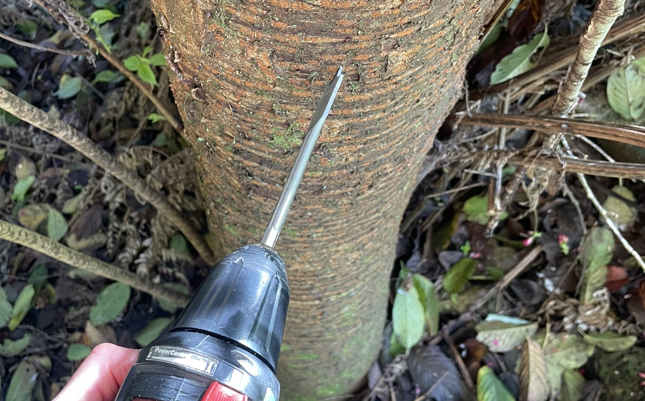
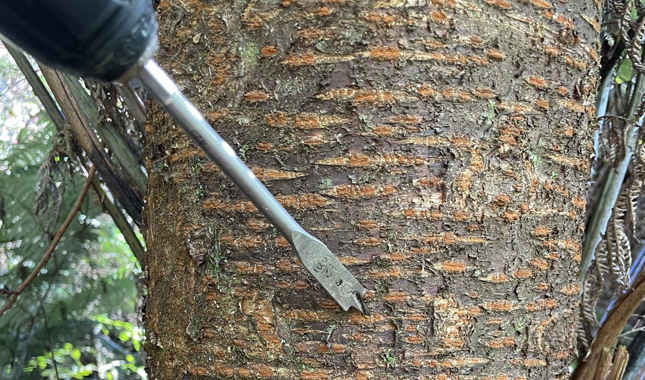
- Apply herbicide immediately after each cut. This is important as the tree will protect itself by trying to seal the cut surface, and we need to make sure the herbicide can get in.
- Repeat the cuts/holes at 15-20cm intervals around the trunk. If there are exposed roots nearby, also create a cut/hole in them as well.
Be sure to return to check your tree regularly. This is a slow process, so patience is needed and you may not see results for several weeks. The timescale will depend on whether the tree is actively growing (spring/summer), the species (woolly nightshade will wilt within a week, Taiwan cherries take about six weeks to show symptoms). Sometimes a follow-up application may be required too.
There’s more information about tree control and other weed control techniques on the Weedbuster’s site.
If you need a small amount of herbicide, someone to show you how to use it, or you could do with a bit of advice, please do get in touch!
 Thames Environmental Alliance